
Light Work: How Biologically Optimised Illumination Is Reshaping Aquaculture Welfare and Production
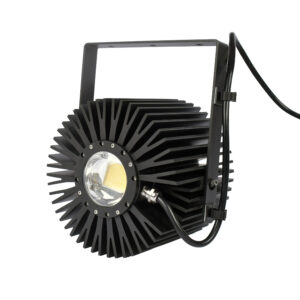 Biosystems, a division of Tropical Marine Centre, launches its most powerful LED fixture to date – the Biolumen Apollo – at Aquaculture UK, Glasgow, June 2026
The Science of Light in Aquatic Systems
Ask most aquaculture operators what their most critical environmental variables are, and you will reliably get answers covering water temperature, dissolved oxygen, feed conversion ratios, and biosecurity. Lighting tends to be an afterthought — something to help the stockmen see what they are doing. That view is increasingly difficult to sustain.
Light is not merely an operational convenience in an aquaculture system; it is an active biological stimulus. The photoperiod — the defined cycle of light and dark — drives melatonin production via the pineal gland in virtually all vertebrates, which in turn entrains circadian rhythms. Those rhythms regulate hormone cascades that influence growth, immune function, stress responses, and reproductive cycling. A fish experiencing chaotic or spectrally inappropriate lighting is, in a meaningful physiological sense, experiencing a chronically disrupted endocrine environment. The practical consequences — suppressed growth rates, elevated cortisol, inconsistent spawning — are well documented and commercially significant.
Spectrum compounds the issue. The visible range for most commercially farmed fish species diverges meaningfully from the human-perceived spectrum of 400–700 nm. Species differ in the wavelengths they rely on for visual acuity, and lighting that appears adequate to the human observer may be substantially sub-optimal for the animals being managed. A poorly specified light source is, from the fish’s perspective, roughly equivalent to running a farm under permanent twilight whilst wondering why feed conversion ratios are disappointing.
Control, then, matters as much as hardware. Gradual dawn and dusk transitions — far from cosmetic — reduce the acute stress associated with abrupt photoperiod changes. Seasonal variation in day length, deliverable via latitude/longitude-based programming, can be used to drive and regulate reproductive cycles, manage smoltification in salmonids, or mirror the natural light environment of a target species’ geographic range.
Introducing the Biolumen Apollo
Biosystems has been developing spectrally tuned LED lighting for biological applications since 2007, accumulating deployment experience across aquaculture, public aquaria, agriculture, and research institutions. The Apollo represents the latest iteration of that work: an IP67-rated LED fixture designed specifically for large-area illumination and deep-water light penetration in demanding commercial environments.
The engineering brief addressed a known failure mode in high-power LED fixtures used in public aquaria and intensive aquaculture: water ingress. Standard high-power LED housings, however well rated at point of manufacture, can prove vulnerable to moisture over extended service periods in humid, splash-prone environments. The Apollo uses a puck-style construction that eliminates this vulnerability by design rather than relying solely on sealing compounds and gaskets. The result is a fixture engineered to maintain consistent performance across its operational life rather than degrading progressively as moisture works its way into sensitive electronics.
The Apollo dims smoothly to 0.1% — significantly lower than most commercial LED systems — enabling genuinely gradual dawn/dusk transitions rather than the abrupt switches that drive acute stress responses. Six biologically optimised spectral profiles cover marine, freshwater, and research applications, with species-specific spectrum sheets available for commercially important fish including Atlantic salmon, sea bass, turbot, cod, and ballan wrasse, mapping Apollo output against published visual sensitivity curves for each species.
Operationally, a remotely mounted driver means maintenance can be carried out without disturbing the fixture itself — a meaningful advantage in difficult-to-access installations. Signal architecture is hard-wired via the BioLumen bus, avoiding the latency, interference, and network security complications of wireless systems. Individual units are fully addressable, so a single installation can run differentiated photoperiod programmes across different tank zones simultaneously, with the signal bus supporting runs of up to 300 metres.
The Biolumen Pro Control: Closing the Loop
The Apollo fixture does not operate in isolation. Its full capability is realised when paired with the Biolumen Pro Control unit — a hardwired biological lighting controller capable of managing up to 128 BioLumen Power Pods, Signal Converters, or compatible third-party light sources from a single device.
The Pro Control is programmable from any web browser over LAN or Wi-Fi, with an interface designed around the practical requirements of facilities management rather than the assumptions of consumer smart-home products. Programmes can be as simple as fixed on/off with ramp times, or as sophisticated as seasonally varying photoperiods derived from real geographic coordinates — a capability with direct application in broodstock management and smoltification protocols.
Critically, the controller supports programme overlay: separate solar and lunar cycle programmes can be applied to the same lights simultaneously, enabling facilities conducting spawning research or managing species with documented lunar breeding cues to implement genuinely multi-layered light environments without requiring additional hardware. The drift function allows programmes to shift gradually over user-defined periods, facilitating smooth seasonal transitions rather than abrupt schedule changes.
For multi-site or multi-species facilities, the ability to address individual lights within a connected network independently — while managing the entire system from a single interface — significantly reduces the operational complexity of running differentiated light environments across a shared infrastructure.
See It at Aquaculture UK 2026
Biosystems will be exhibiting at Aquaculture UK in Glasgow in June 2026. The Apollo and the full Biolumen control system will be on demonstration at Stand C101.
Further product information, species spectrum sheets, and technical specifications are available at https://biosystems-tmc.com/uk/biolumen-apollo.