
NARA Climate and University of Stirling Develop Sustainable Halophyte Feed
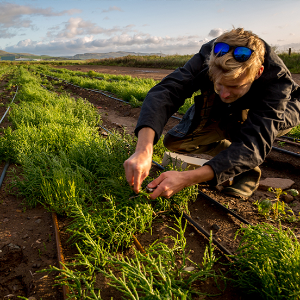
NARA Climate and the University of Stirling have partnered to develop novel aquaculture feed ingredients derived from halophytes cultivated on restored coastal ecosystems, including saltmarshes and mangroves. The collaboration focuses on generating lower-footprint, climate-resilient feed ingredients that can contribute to more diversified aquafeed supply chains while supporting coastal ecosystem restoration and blue carbon initiatives.
Thanks to funding from the National Alternative Protein Innovation Centre (NAPIC), current work, led by Dr Amina Moss, Professor Monica Betancor and Dr Stuart McMillan at Stirling’s world-renowned Institute of Aquaculture, is evaluating halophyte-derived raw materials, including Salicornia and Atriplex, as partial replacement for less sustainable plant proteins, notably soy, in aquaculture feeds. Halophytes are particularly attractive as future feed ingredients because they can be cultivated using saline water on degraded or non-arable coastal land, avoiding direct competition with freshwater resources and conventional agricultural land used for human food production. This offers strong advantages from both land-use and life cycle assessment (LCA) perspectives, particularly as aquaculture producers seek to reduce Scope 3 emissions associated with imported feed ingredients. Unlike many conventional crops, halophytes are naturally abundant across UK coastlines, creating opportunities for regionally sourced and potentially lower-emission feed ingredient supply chains.

Ingredient processing methods include fermentation, biomass fractionation, juicing, and concentration approaches aimed at improving nutrient density, ingredient functionality, and processing suitability for feed applications. Preliminary analyses conducted at the University of Stirling demonstrated that processing substantially improved the nutritional profile of halophyte fractions. In particular, juicing approaches increased crude protein levels by more than two-fold. Processing also resulted in major increases in nutritionally relevant amino acids. Total amino acid concentrations increased more than five-fold in processed Salicornia fractions, while key amino acids relevant to Atlantic salmon nutrition, including lysine, methionine, leucine, isoleucine, and valine, showed marked enrichment following processing and fractionation. These findings suggest that bio-refining approaches may improve the suitability of halophyte biomass as a supplementary ingredient within lower-footprint Atlantic salmon feed formulations.
Beyond protein production, halophytes are also naturally rich in polyphenols, flavonoids, carotenoids, and other antioxidant compounds produced as part of their adaptation to highly saline and environmentally stressful coastal conditions.
Dr Amina Moss, who is leading the project, said: “Research has shown that saline stress can further stimulate the accumulation of these bioactive compounds in halophytes, increasing antioxidant activity and phytochemical concentrations. This creates additional interest in halophytes as functional feed ingredients, particularly for Atlantic salmon aquaculture where oxidative stress resilience, ingredient stability, and fish health are increasingly important considerations within feed formulation strategies.”
The project aims to assess whether halophyte-derived ingredients could partially replace conventional feed materials associated with high land, freshwater, and carbon footprints, including imported soy-based ingredients. In addition to nutrient production, halophyte cultivation systems may provide ecosystem co-benefits including nutrient capture, carbon sequestration, shoreline stabilisation, and restoration-linked biomass generation, supporting the development of more circular and environmentally integrated aquaculture supply chains.
The partnership is now progressing towards digestibility, palatability, and feed utilisation studies to assess the suitability of these ingredients in Atlantic salmon in the University of Stirling’s newly renovated seawater National Aquaculture Technology Hub (NATIH marine) aquaculture facilities in Machrihanish. Alongside nutritional performance, the project is also exploring the scalability of restoration-linked biomass production systems capable of supporting future lower-emission aquafeed production at industrial scale.