
Water, Growth and the Infrastructure Keeping Pace
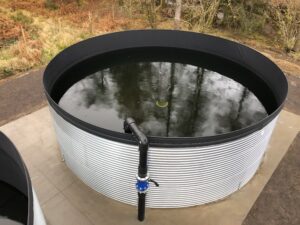 How modular steel storage is evolving alongside a changing aquaculture industry
Aquaculture is one of the success stories of modern food production. It now supplies more than half of all fish consumed globally, and growing. As wild catch flatlines and the global population continues to rise, farmed fish, shellfish and seaweed have moved from the margins of the food system to its centre. The farms driving that shift are becoming larger, more technically sophisticated and more capital-intensive than at any point in the industry’s history.
Water underpins every aquaculture operation. Not just availability, but quality, consistency and the ability to store and manage it reliably over time. It is the one input that cannot be substituted, reduced or worked around. Increasingly, the farms that secure and control that variable outperform those that don’t.
The conversation about water in aquaculture has shifted significantly. Climate variability is altering rainfall patterns, abstraction rights are under renewed scrutiny, and coastal sites face rising temperatures and shifting salinity. Meanwhile, high-density production systems are increasingly sensitive to instability. In RAS environments, where up to 99% of water is continuously reused, secure storage is critical. A single weakness at that point can compromise the entire operation.
The result is an industry that is investing heavily in water management infrastructure, and rethinking what that infrastructure needs to look like.
Rethinking What Storage Means
Water storage in aquaculture has traditionally meant in-ground lagoons or cast concrete reservoirs: infrastructure built once, in fixed volumes, and expected to remain unchanged for a generation. That model made sense when farms were smaller, growth was incremental and pressure on water sources was lower.
Today, those assumptions no longer hold. Lagoons depend heavily on ground conditions and ongoing monitoring to maintain integrity. Concrete structures require significant civil works, long lead times and offer limited flexibility once installed.
Modular steel tanks provide a different approach. Capacity can be scaled as operations expand. Installation is faster and less disruptive. As above-ground assets, tanks remain accessible for inspection, maintenance and modification throughout their working life. In an environment defined by regulatory scrutiny and production sensitivity, that adaptability delivers long-term resilience.
 Infrastructure Built for How the Industry Actually Works
For more than 30 years, Evenproducts has provided water storage solutions to sectors facing many of the same challenges now shaping aquaculture: environmental pressure, precision water management and the need for long-term structural reliability.
Our modular corrugated steel tanks are engineered for that environment. Manufactured from structural grade S280 and S390 steel and certified to ISO 9001 and BS EN 1090 Class II, each design incorporates a 40% structural safety margin. Systems are available in a wide range of diameters and heights, scaling beyond 5,000 m³ to support both standalone installations and large integrated facilities. MagiZinc® ZM310 coating delivers enhanced corrosion resistance, particularly valuable in coastal and high-humidity locations, while optional RAL powder coating provides additional protection and allows tanks to integrate discreetly within sensitive or visually exposed sites.
Internally, liner systems are specified according to application. Butyl, EPDM and reinforced PVC options are selected based on water chemistry, temperature and species requirements, ensuring compatibility across freshwater, brackish and marine installations.
The result is a scalable, inspectable storage solution designed to support controlled, resilient water management as aquaculture continues to evolve.
Planning for a More Demanding Future
Global aquaculture production is projected to grow significantly by 2050. The farms that lead that growth will not simply be the largest, but the best prepared. Infrastructure that can adapt to tighter regulation, environmental variability and rising performance expectations will define long-term success.
Evenproducts works alongside engineers, contractors and operators worldwide, supporting projects from early design and specification through to delivery, guided installation and ongoing aftercare. Decisions around volume, configuration, materials and integration are most effective when addressed at the planning stage, not after construction begins.
Water storage remains fundamental. What has changed is the level of precision, resilience and adaptability now required from it. For farms investing with that in mind, the right infrastructure does more than store water. It secures performance.
Evenproducts is a supply chain partner to organisations including Severn Trent, Netafim and UNICEF.